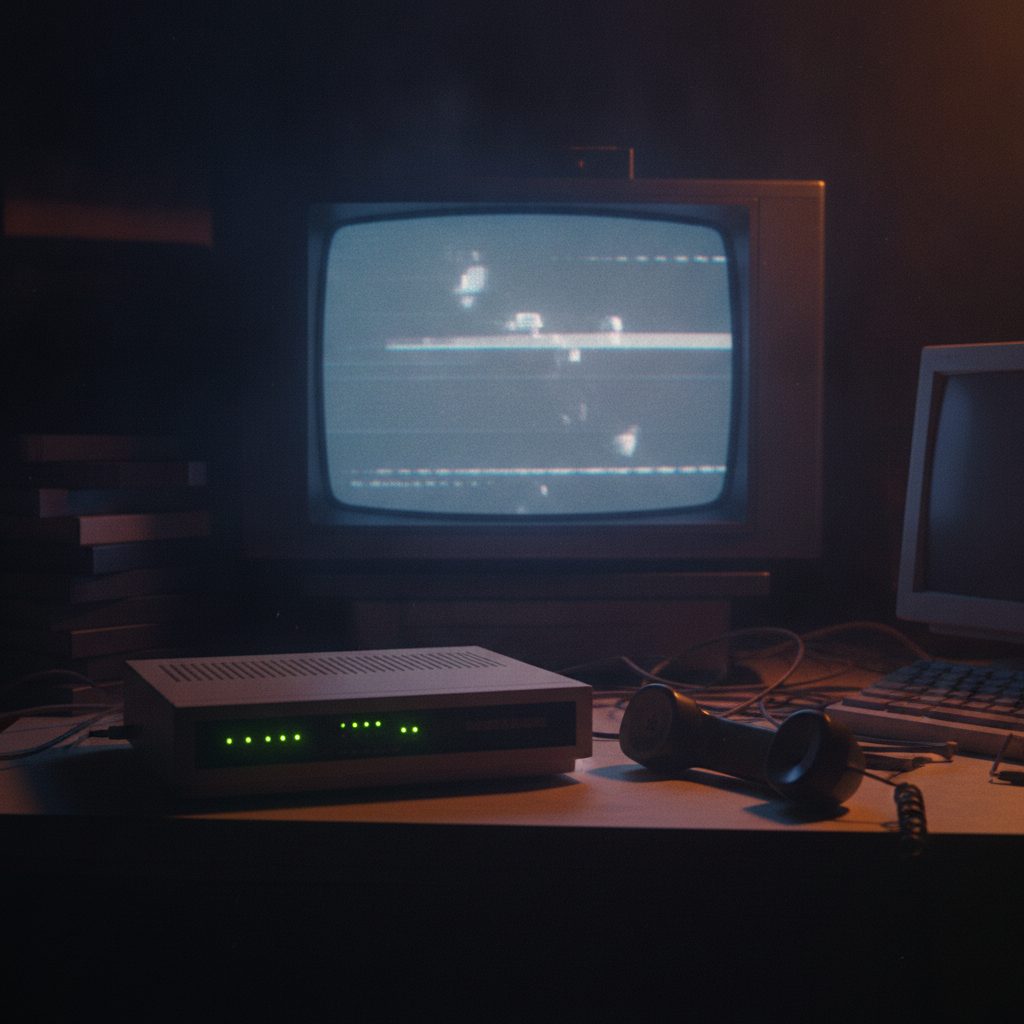
If you were around in the 1990s, you remember the sacred ritual of getting online. Connecting to the internet was not a silent background process. It was a full audio spectacle that broadcasted your digital ambitions to everyone within earshot. That legendary modem handshake sound, a cacophony of chirps, static, and high-pitched squeals, was not just random noise. It was a complex negotiation taking place over analog phone lines. The two modems were actively handshaking by testing frequencies, assessing noise on the line, and agreeing on maximum transmission capabilities before handing off to data transfer.
In the early to mid-1990s, cruising the web meant putting up with modest connection speeds. A speed of 28.8 kilobits per second (28.8k) felt like a major upgrade, but downloading a single high-resolution image could easily take several minutes. Hardware companies later pushed technology up to 56 kilobits per second (56k), though competing proprietary standards like X2 and K56flex initially split the market. The International Telecommunication Union solved the compatibility headache by approving the unified V.90 standard in 1998, establishing an official benchmark for 56k dial-up modems.
Because dial-up relied on existing copper infrastructure, connecting to the web meant monopolizing your household telephone line. If someone picked up the kitchen receiver while you were halfway through downloading a file, your connection immediately collapsed into static. Incoming callers received a persistent busy signal, leading to endless household arguments over who got to use the line. If you wanted to browse the web without causing family drama, you had to wait until late at night or persuade your parents to install a second phone line.
To get millions of households hooked on this new digital frontier, America Online blanketed the nation with direct mail campaigns. Floppy disks and CD-ROMs arrived in mailboxes, magazine inserts, and retail checkout counters everywhere. AOL spent hundreds of millions of dollars distributing trial discs offering hundreds of free hours. Millions of homes ended up using the shiny silver discs as coasters, frisbees, or craft projects simply because there were far too many to ever use.
For years, staying online was an expensive venture because service providers charged customers by the hour. That business model shifted dramatically in December 1996, when AOL introduced a flat rate of $19.95 per month for unlimited access. The response was overwhelming. Millions of users logged on and stayed connected, causing widespread network congestion, constant busy signals, and frustrated subscribers. Despite the temporary network strain, the move to flat-rate pricing transformed how people consumed online content.
Eventually, the physical limitations of copper voice lines forced the technology world to look forward. By the early 2000s, high-speed broadband connections such as DSL and cable internet began replacing dial-up access across the country. Broadband offered always-on connectivity at speeds that made 56k modems look like snail mail, without ever occupying the household phone line. Dial-up gradually faded into history, but the nostalgic memory of that noisy handshake remains an iconic symbol of early internet culture.



Be the first to say something.